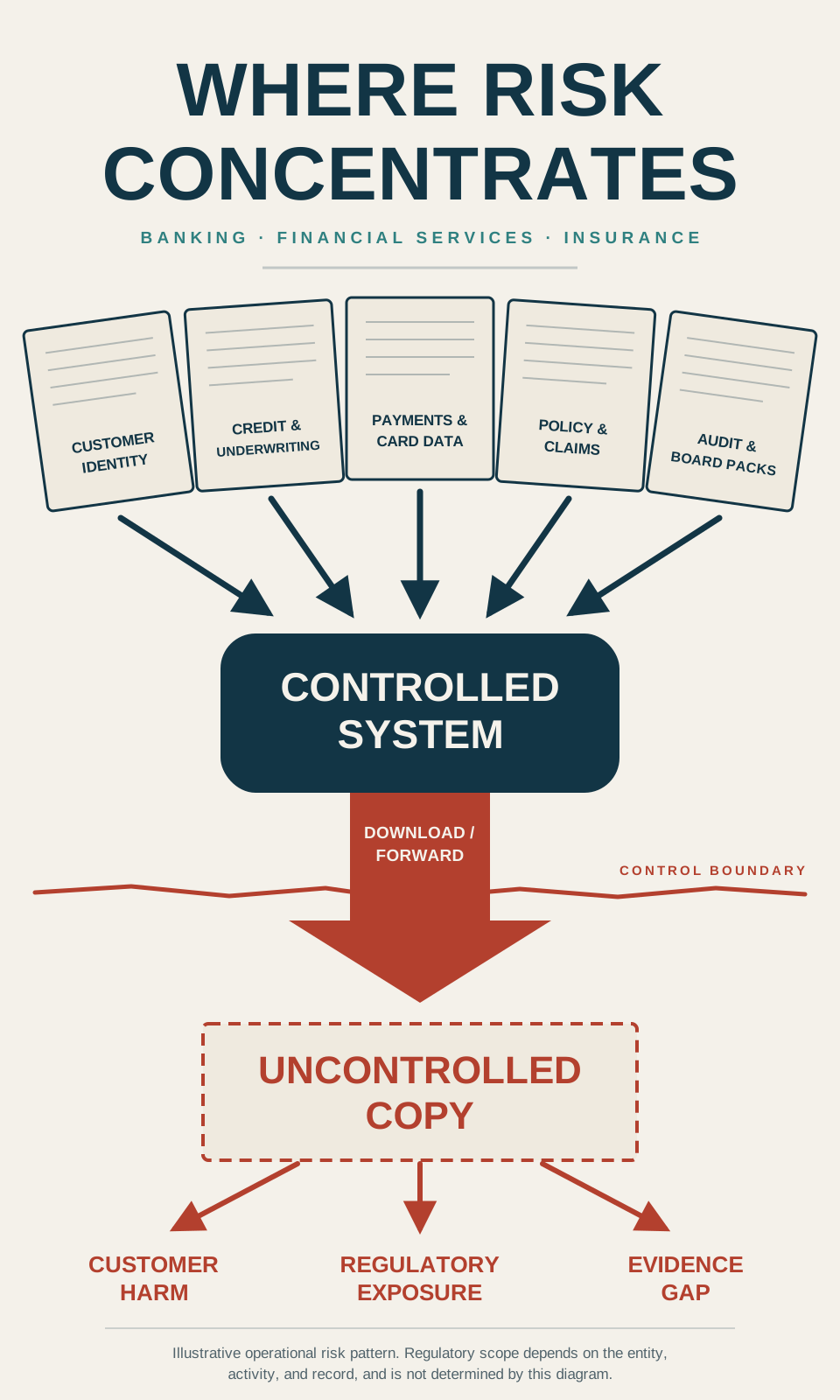
Customer files move between branches, underwriting teams, claims assessors, auditors, collection partners, and service providers. A download or email attachment can become a copy outside the original system.
Use file-level controls where the risk depends on who opens, forwards, prints, or retains the document.
Document exposure changes as customer, credit, payment, claims, and review files move between branches, underwriters, assessors, auditors, and service providers. Select a column to inspect the handoff risk it represents.
Illustrative exposure pattern, not live security telemetry
Selected threat
Customer Identity
KYC packs and account opening files can be retained by a third party after the underlying task is complete.
Protected and controlledElevated or exposed risk
The file is often the last mile
A Shared File Is A Separate Risk Decision
Identity, application, and network controls govern the systems around a financial record. The exposure changes when a customer file, review pack, or evidence export is retained, forwarded, or altered outside that system.
This is a practical risk view. It is not a determination of regulatory applicability or compliance.
View the risk routeExpand full screen
India
Scope depends on the regulated entity and activity
RBI's Master Direction on Information Technology Governance, Risk, Controls and Assurance Practices (November 2023, effective April 2024) applies to the listed banks, NBFCs, credit information companies, and All India Financial Institutions. It addresses, among other areas, information-asset classification, access and cryptographic controls, audit trails, third-party arrangements, incident response, and IS audit.
SEBI's Cybersecurity and Cyber Resilience Framework, issued by circular of 20 August 2024, applies to SEBI Regulated Entities on a graded basis by category. Implementation timelines have since been extended and clarified, so the current circulars should be checked for the applicable dates.
IRDAI's Information and Cyber Security Guidelines, 2023 require a board-approved policy and NIST-aligned controls with periodic audit for insurers and regulated intermediaries. Applicability is tiered in the annexures, and certain individual agents and surveyors sit outside their direct purview.
Section 8(5) of the Digital Personal Data Protection Act, 2023 requires a Data Fiduciary to protect personal data in its possession or under its control, including processing carried out on its behalf by a Data Processor, by taking reasonable security safeguards. The Schedule provides a penalty that may extend to two hundred and fifty crore rupees for breach of that obligation, as determined by the Board.
The CERT-In Directions of 28 April 2022 require service providers, intermediaries, data centres, body corporate, and Government organisations to report the cyber incidents listed in Annexure I within six hours of noticing them or being brought to notice about them.
For non-banking financial institutions within FTC jurisdiction, the Safeguards Rule requires a written information security program. Its elements include encryption of customer information in transit and at rest, or reviewed and approved effective alternative controls, alongside access controls, secure disposal, and monitoring of authorised user activity, subject to the rule's exemptions.
The SEC's May 2024 amendments to Regulation S-P require broker-dealers, investment companies, registered investment advisers, and transfer agents to adopt incident response program policies and procedures, and require covered institutions to give notice as soon as practicable, and not later than 30 days, after becoming aware of a qualifying incident.
23 NYCRR Part 500 applies to covered entities operating under, or required to operate under, a licence, registration, charter, or similar authorisation under New York's Banking, Insurance, or Financial Services Law. The Second Amendment adds governance, access, and risk-assessment obligations, subject to the tiered exemptions.
European Union
Scope depends on the financial entity and processing
Regulation (EU) 2022/2554 applies from 17 January 2025 to financial entities within its scope, subject to the stated exclusions. It requires an ICT risk management framework under management-body oversight and the reporting of major ICT-related incidents to competent authorities.
DORA also governs arrangements with ICT third-party service providers, including a register of information, pre-contractual due diligence, and contractual safeguards where the arrangement supports critical or important functions.
Article 32 of Regulation (EU) 2016/679 lists pseudonymisation and encryption of personal data among the measures to be applied as appropriate to the risk. Article 83(4) places infringements of Article 32 in the tier of administrative fines up to 10 million euro, or up to 2% of total worldwide annual turnover of the preceding financial year, whichever is higher.
Ranked by business exposure
Priority Financial Records
Swipe the wheel or tap a record class.Drag, scroll, click, or use the arrow keys to move between record classes without changing the layout.
A KYC file, account opening pack, statement, loan application, or claim attachment is sent to a wrong recipient or retained by a third party after the underlying task is complete.
02
Common stopping point
Core systems, portals, and email gateways can control entry and transfer. An exported attachment can become a separate copy with different storage, forwarding, and retention conditions.
03
Stronger practice
Classify the record, use named-recipient release where appropriate, set permitted use and expiry, record activity, and include access withdrawal in the organization’s offboarding process.
04
Cost of inaction
For RBI-regulated entities within scope, information-asset security classification, access controls, cryptographic controls, and audit trails are part of the IT control framework. Where the DPDP Act applies, its Schedule provides a penalty that may extend to two hundred and fifty crore rupees for failure to take reasonable security safeguards.
Operational risk map only. Regulatory scope depends on the entity, service, data, and current direction. Linked regulator sources are authoritative. File controls support a wider governance, security, resilience, and response program; they do not establish compliance by themselves.
Operational risk map only. Regulatory scope depends on the entity, service, data, and current direction. Linked regulator sources are authoritative. File controls support a wider governance, security, resilience, and response program; they do not establish compliance by themselves.
Documented industry incidents
The Cost Is Real
Financial-sector data exposure has already reached decommissioned hardware, document repositories, and supervisory examinations. In each case a regulator put the failure on the record.
$35M
SEC penalty for safeguard failures
Case 01
The Copy Outlived The System
Case date
Conduct from 2015; SEC order September 20, 2022
Case location
Data centres in Poughkeepsie, New York and Columbus, Ohio
Morgan Stanley Smith Barney decommissioned two data centres in 2016 using a moving and storage company that the SEC's order says had no experience with, or expertise in, data destruction services. The order records that approximately 4,900 IT assets, including unwiped hard drives, were sold on, and the press release states devices were resold on an internet auction site without removal of customer information.
What Morgan Stanley Faced
The SEC found extensive failures over a five-year period affecting approximately 15 million customers, and MSSB agreed to a $35 million penalty for violating the Safeguards Rule and the Disposal Rule under Regulation S-P. In a separate 2020 action on the same decommissioning conduct, the OCC assessed a $60 million civil money penalty against two Morgan Stanley national banks.
Publicly documented incidents. The organizations named are not represented as Vaultize customers, and no claim is made that Vaultize would have prevented these events. Dates, locations, leadership roles, figures, and consequences follow the linked primary sources; undisclosed locations are identified as not disclosed. Penalties imposed by different regulators on different legal entities are stated separately and are not combined.
A deliberate control trail
Make The Release Decision Reviewable
Use the file-level route as part of a broader program. The objective is a clear answer to what was released, to whom, under what conditions, and what activity followed.
Controlled document route
A concise record around a high-risk exchange
ContextRecipientUseExpiryEventsRecovery
01
Define Priority Records
Start with the customer, credit, payment, claims, audit, and partner files that leave the primary system most often or create the largest confidentiality, integrity, or availability exposure.
02
Classify By Business Context
Connect the file to its sensitivity, owner, purpose, and route so the release decision reflects more than a generic document type.
03
Release To A Known Recipient
Apply the organization’s approved identity, access, and approval process before sharing a high-risk file externally or across an internal boundary.
04
Bound Permitted Use
Set the relevant access, forwarding, printing, copying, and time conditions for the record and workflow, subject to the organization’s policy and technical environment.
05
Retain Evidence For Review
Keep release, access, policy-change, revocation, and recovery evidence available to the responsible security, operations, audit, and incident teams.
Common financial service routes
Start Where Files Change Hands
BFSI information moves from onboarding through underwriting, servicing, claims, supervision, and recovery. The map shows where file-level control must remain connected as documents cross each handoff.
BFSI business lifecycleFour priority control points
01
Lending And Underwriting
Control application packs, credit assessments, collateral documents, and valuation files as they move between internal teams and approved service providers.
Purpose-bound credit review
02
Claims And Customer Service
Apply a bounded release route to customer, policy, claims, dispute, and settlement documents used by authorized operational teams and external assessors.
Accountable customer exchange
03
Audit And Supervisory Review
Keep board packs, audit collections, review exports, and regulatory responses attributable while they are prepared, reviewed, and updated.
Traceable review evidence
04
Third-Party Operations
Define a controlled file route for processors, brokers, TPAs, agencies, counsel, auditors, and other partners handling sensitive operating records.
Governed external handoff
Bring one file route
Make One Release Decision Reviewable
Walk through the records, recipients, permitted use, and evidence a responsible team can verify.