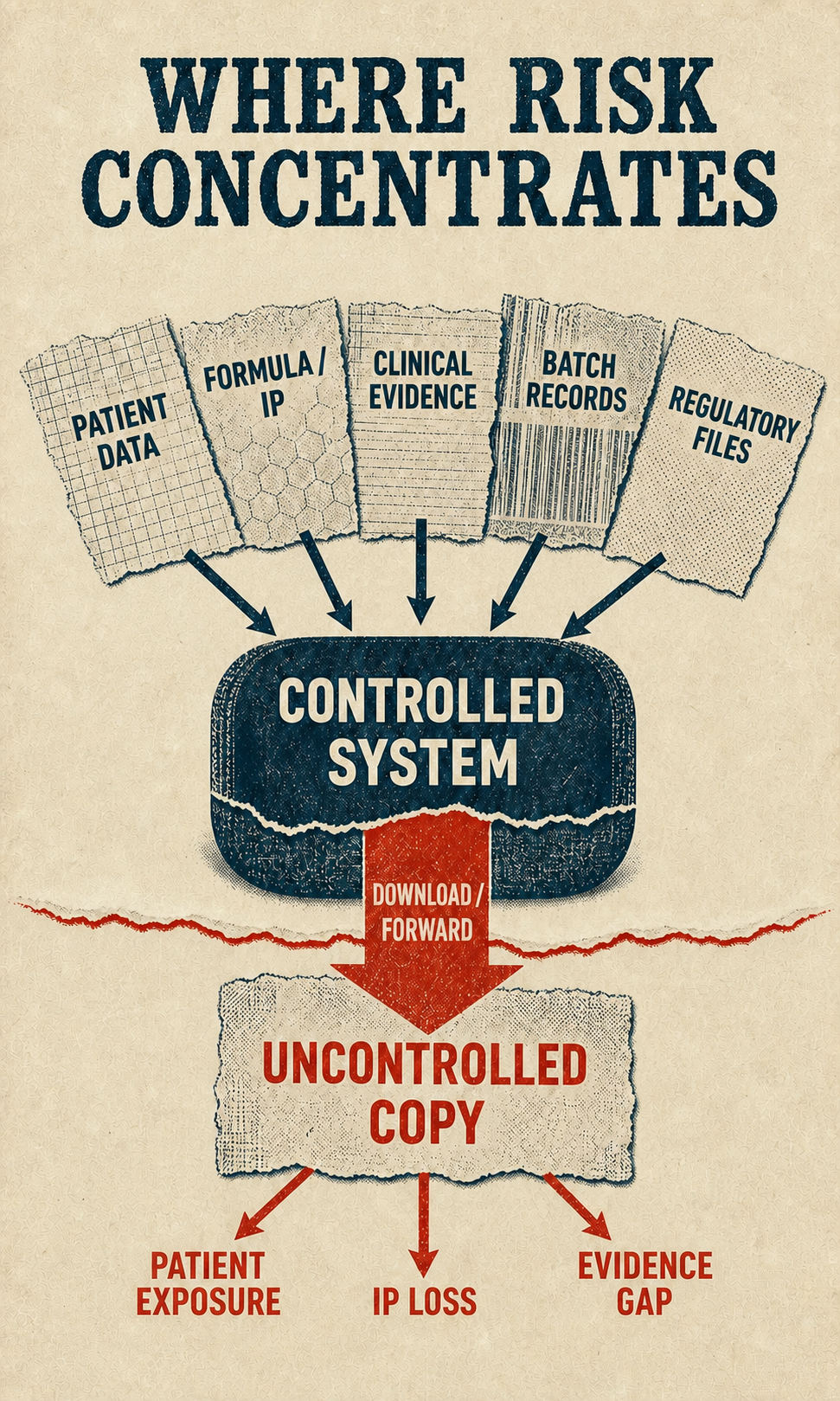
Clinical evidence crosses sites, CROs, laboratories, partners, and reviewers. Once downloaded, access can outlive its approved purpose and critical evidence can become harder to trace.
Vaultize keeps identity, usage rights, and audit evidence attached wherever the file travels.
Document exposure changes as sensitive files move between sites, CROs, laboratories, partners, and reviewers. Select a column to inspect the handoff risk it represents.
Illustrative exposure pattern, not live security telemetry
Selected threat
Patient Data
Identifiable trial or care records can outlive approved partner access after download or forwarding.
Protected and controlledElevated or exposed risk
Control path
How Exposure Becomes Business Risk
The highest-impact leaks combine patient harm, regulatory evidence, manufacturing integrity, intellectual property, and business continuity. The control requirement changes with the record, recipient, and jurisdiction.
Priority reflects combined patient, regulatory, IP, and operational impact,not a legal hierarchy.
Core safeguard and breach provisions are scheduled eighteen months after 13 November 2025. When applicable, the Act's schedule permits penalties up to ₹250 crore for failure to take reasonable security safeguards.
HIPAA safeguards and breach duties apply to covered entities and business associates handling ePHI,not automatically to every pharmaceutical company or every record.
FDA expects CGMP data to remain complete, consistent, accurate, attributable, legible, contemporaneous, original or a true copy, and traceable through its lifecycle.
FDA Part 11 guidance treats audit trails and controls as risk-based measures supporting trustworthy electronic records; applicable predicate recordkeeping requirements remain enforceable.
Ranked by combined exposure
Highest-Value Pharma Records
Swipe the wheel or tap a record class.Drag, scroll, click, or use the arrow keys to move between record classes without changing the layout.
Swipe or tapDrag or scroll03 / 05
Patient
Formula
Clinical
Batch
Regulatory
Clinical And Safety Evidence
03
Approvals · subject safety · data integrity
Clinical And Safety Evidence
01
Leak scenario
Unblinded data, case-report exports, consent records, adverse-event files, protocol deviations, or statistical outputs move between sponsor, site, CRO, laboratory, and regulator as attachments or local exports.
02
Common stopping point
EDC and eTMF permissions govern the primary system, but review exports, emailed attachments, and locally retained working files can diverge from the authoritative record.
03
Stronger practice
Keep attributable versions and metadata, control every export, preserve audit trails, prevent silent replacement, restrict onward use, and retain true originals or validated copies for the required period.
04
Cost of inaction
FDA states that sponsors are responsible for study-data integrity and has declared studies from named laboratories unacceptable. Unreliable evidence can therefore require replacement support and delay a regulatory decision.
Operational risk map only. Regulatory scope depends on the entity, record, processing purpose, and effective date. Linked government sources are the authority; stronger practices are control recommendations, not claims that any single technology guarantees compliance or prevents every incident.
Operational risk map only. Regulatory scope depends on the entity, record, processing purpose, and effective date. Linked government sources are the authority; stronger practices are control recommendations, not claims that any single technology guarantees compliance or prevents every incident.
Documented industry incidents
The Cost Is Real
Pharmaceutical data loss has already reached patient-support ecosystems, research IP, manufacturing, and global operations.
1.7M+
patient records involved
Case 01
Patient Data Outlived Partnership
Case date
Discovered February 2024; Amgen notified April 2024
Case location
Former vendor subsidiary; geographic location not disclosed
A former patient-support vendor retained patient data after its work for Amgen ended, as required by FDA rules. In 2024, that vendor reported a cybersecurity incident involving the retained records.
What Amgen Faced
Identifiable health information belonging to more than 1.7 million patients was involved. Amgen notified the FTC and disclosed the event in its Form 10-K, while reporting no material adverse business effect from the vendor breaches.
Publicly documented incidents. The organizations named are not represented as Vaultize customers, and no claim is made that Vaultize would have prevented these events. Dates, locations, leadership roles, figures, and consequences follow the linked primary sources; undisclosed locations are identified as not disclosed.
The governed journey
Control Must Travel
Protection begins before release and remains connected to identity, purpose, usage, policy, and evidence.
Identify sensitive clinical, personal, regulatory, and research files before they enter an external workflow.
02
Protect Before Release
Encrypt the file and bind viewing, editing, printing, copying, and sharing rights to it.
03
Limit Every Handoff
Authorize investigators, sites, CROs, partners, and reviewers for a defined purpose and period.
04
Revoke After Distribution
Change policy, expire access, or withdraw a distributed file when the approved purpose ends.
05
Preserve The Evidence
Retain attributable access and policy events alongside protected versions for recovery.
High-risk workflows
Built For Clinical Work
Pharma information moves from discovery to trials, review, production, distribution, and care. The map shows where file-level control must remain connected as documents cross each handoff.
Pharma business lifecycleFour priority control points
01
Clinical Trial Exchange
Control study documents shared across sponsors, investigators, sites, and CROs.
Study files retain policy
02
Regulatory Submissions
Keep submission packages governed and review activity attributable across approved teams.
Review stays traceable
03
Research Partnerships
Limit use of sensitive research and intellectual property during external collaboration.
Purpose-bound access
04
Patient Information
Apply persistent file controls to sensitive personal and care-related documents.
Rights follow the file
Bring one clinical workflow
See Where Control Must Travel
Walk through the study documents, recipients, jurisdictions, and evidence requirements in your environment.