Law Firms, In-House Legal, And Professional Services
Share the matter file. keep privilege and control attached
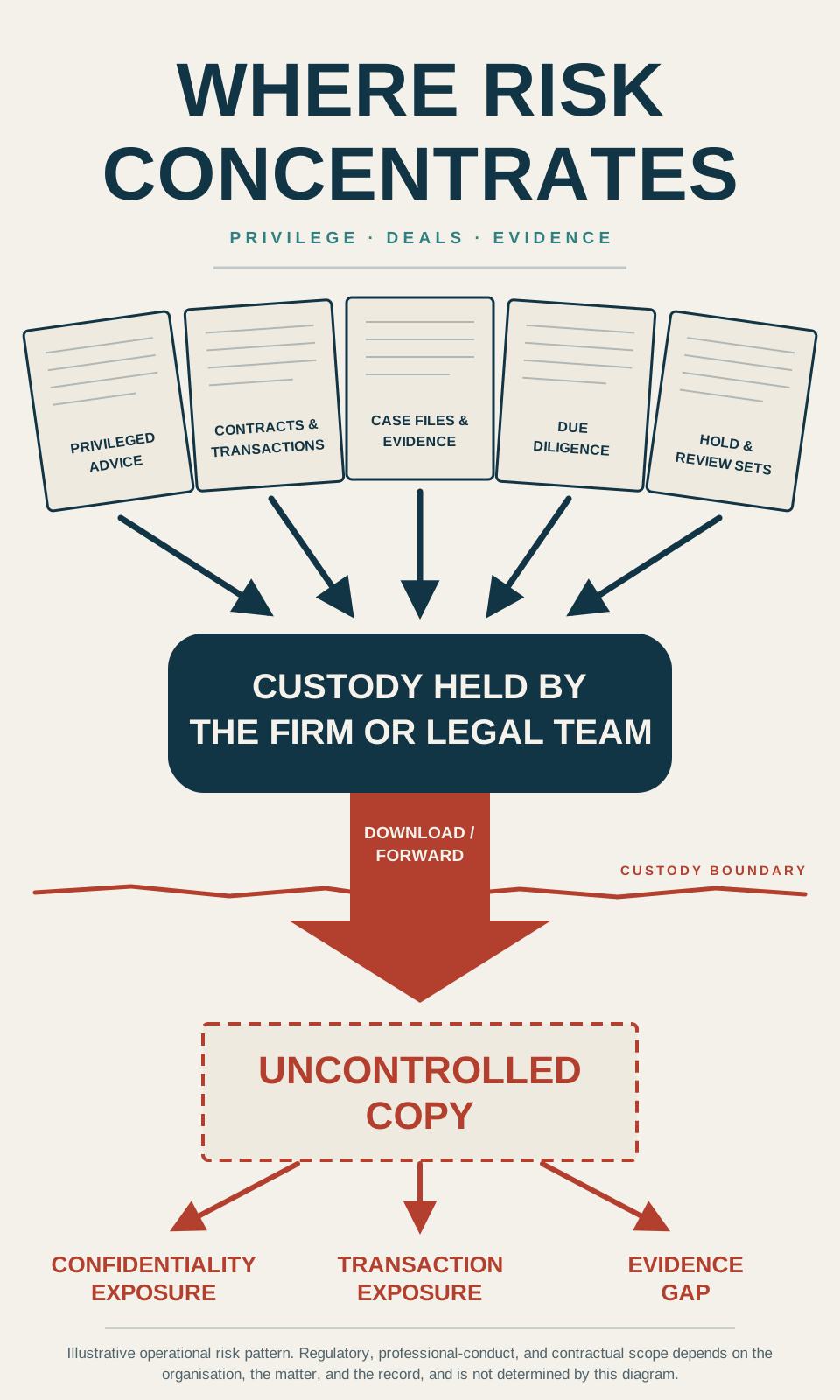
Deal rooms, case teams, experts, clients, and counterparties all need document access. Advice, bundles, diligence packs, and review collections leave the firm as a matter of routine, and a download or an email attachment can become a copy that outlives the matter it was created for.
Vaultize applies persistent rights to the document itself, with source-side encryption and customer-controlled keys, and is deployed on-premises, in private cloud, sovereign cloud, hosted, hybrid, or air-gapped environments, so a matter file can move while custody stays with the firm or the legal team.
Document exposure changes as advice, transaction, evidence, and review material moves between matter teams, clients, co-counsel, experts, bidders, and counterparties. Select a column to inspect the handoff risk it represents.
Illustrative exposure pattern, not live security telemetry
Selected threat
Privileged Advice
Opinions, memoranda, and client correspondence are delivered by email, and the body travels further than the sender can see.
Protected and controlledElevated or exposed risk
The file is often the last mile
A Released Matter Document Is A Separate Risk Decision
Document management systems, engagement letters, and confidentiality undertakings govern the systems and the relationship around a matter. The exposure changes when an opinion, contract draft, bundle, diligence pack, or review set is downloaded, forwarded, or retained outside that system.
This is a practical risk view. It is not a determination of regulatory, professional-conduct, or contractual applicability or compliance, and it is not legal advice.
View the risk routeExpand full screen
India
Scope depends on the entity, the matter, the data, and the system
The Bar Council of India's Standards of Professional Conduct and Etiquette, framed under the Advocates Act, 1961, provide at Rule 17 of the section on an advocate's duty to the client that an advocate shall not, directly or indirectly, commit a breach of the obligations imposed by Section 126 of the Indian Evidence Act. The Council's own summary of the same duty states that an advocate should not by any means, directly or indirectly, disclose the communications made by his client to him. The cross-referenced Evidence Act section has since been replaced by the Bharatiya Sakshya Adhiniyam, 2023, so the professional-conduct duty now reads across to that Act.
Section 132(1) of the Bharatiya Sakshya Adhiniyam, 2023, notified as Act No. 47 of 2023 in the Gazette of India of 25 December 2023, provides that no advocate shall at any time be permitted, unless with his client's express consent, to disclose any communication made to him in the course and for the purpose of his service as such advocate. The Explanation records that the obligation continues after the service has ceased, and sub-section (3) extends it to interpreters, clerks, and employees of advocates. Section 134 protects confidential communications with a legal adviser from compelled disclosure. Provisos exclude communications made in furtherance of any illegal purpose.
Section 8(5) of the Digital Personal Data Protection Act, 2023 requires a Data Fiduciary to protect personal data in its possession or under its control, including processing carried out on its behalf by a Data Processor, by taking reasonable security safeguards to prevent personal data breach. The Schedule provides a penalty that may extend to two hundred and fifty crore rupees for breach of that obligation, as determined by the Board. Matter files routinely carry client, witness, employee, and counterparty personal data.
Section 17(1) of the same Act exempts specified processing from most of Chapter II, including at clause (a) processing necessary for enforcing any legal right or claim, at clause (b) processing by any court or tribunal or other body entrusted by law with a judicial, quasi-judicial, regulatory, or supervisory function where that processing is necessary for the performance of the function, and at clause (c) processing in the interest of prevention, detection, investigation, or prosecution of an offence or contravention of law. The exemption is expressed to leave Sections 8(1) and 8(5) applicable, so the security-safeguards duty is not switched off by litigation or investigation work.
The CERT-In Directions of 28 April 2022 require service providers, intermediaries, data centres, body corporate, and Government organisations to report the cyber incidents listed in Annexure I within six hours of noticing them or being brought to notice about them. Annexure I expressly includes unauthorised access of IT systems or data, data breach, and data leak, which is the category a compromised matter repository or mailbox falls into.
Cross-Border Matters And Client Mandates
Scope depends on the client, the mandate, the forum, and the data
Article 32 of Regulation (EU) 2016/679 requires the controller and the processor to implement appropriate technical and organisational measures to ensure a level of security appropriate to the risk, and names pseudonymisation and encryption of personal data among them. Article 83(4) places infringements of Article 32 in the tier of administrative fines up to 10 million euro, or up to 2% of total worldwide annual turnover of the preceding financial year, whichever is higher. This reaches an Indian adviser through European client, employee, and counterparty data.
Paragraph 6.3 of the Solicitors Regulation Authority's Code of Conduct for Solicitors, RELs and RFLs states that you keep the affairs of current and former clients confidential unless disclosure is required or permitted by law or the client consents. Indian firms and professional-services teams encounter this standard through instructing solicitors and co-counsel arrangements in England and Wales rather than directly.
Model Rule 1.6(c) of the American Bar Association's Model Rules of Professional Conduct provides that a lawyer shall make reasonable efforts to prevent the inadvertent or unauthorized disclosure of, or unauthorized access to, information relating to the representation of a client. The Model Rules are a template that United States jurisdictions adopt with variations, so the operative text is the one adopted by the relevant state.
ABA Formal Opinion 477R of May 2017 states that a lawyer generally may transmit information relating to the representation of a client over the internet without violating the Model Rules where the lawyer has undertaken reasonable efforts to prevent inadvertent or unauthorized access. Formal Opinion 483 of October 2018 states that when a data breach occurs involving, or having a substantial likelihood of involving, material client information, lawyers have a duty to notify clients of the breach.
Rule 26(c)(1) of the Federal Rules of Civil Procedure allows a court, for good cause, to issue an order to protect a party or person from annoyance, embarrassment, oppression, or undue burden or expense, and Rule 26(c)(1)(G) allows an order requiring that a trade secret or other confidential research, development, or commercial information not be revealed or be revealed only in a specified way. Rule 34 governs production of designated documents or electronically stored information stored in any medium from which information can be obtained.
Deal Rooms, Diligence, And Price Sensitive Information
Scope depends on the listed entity, the transaction, and the adviser's role
Regulation 3(1) of the SEBI (Prohibition of Insider Trading) Regulations, 2015 provides that no insider shall communicate, provide, or allow access to unpublished price sensitive information except where the communication is in furtherance of legitimate purposes, performance of duties, or discharge of legal obligations. The Explanation to Regulation 3(2A) records that a legitimate purpose includes sharing such information in the ordinary course of business with partners, collaborators, lenders, customers, suppliers, merchant bankers, legal advisors, auditors, insolvency professionals, or other advisors and consultants. The permission is bounded by purpose, which is exactly what a deal-room release decision has to express.
Regulation 3(5) of the same Regulations requires the structured digital database recording the nature of unpublished price sensitive information and the persons who shared or received it to be maintained internally, not outsourced, with adequate internal controls and checks such as time stamping and audit trails to ensure non-tampering. Regulation 3(6) requires it to be preserved for not less than eight years after completion of the relevant transactions, and longer where SEBI proceedings are under way. Advisers to a listed client sit inside that record.
Section 132 of the Bharatiya Sakshya Adhiniyam, 2023 bars an advocate from disclosing communications made in the course and for the purpose of the service without the client's express consent, and the Explanation records that the obligation continues after the service has ceased. A diligence data room that outlives the transaction, on storage the client's advisers do not administer, is a practical problem for that continuing obligation rather than a determination about it.
Section 42A of the Arbitration and Conciliation Act, 1996, inserted by Section 9 of the Arbitration and Conciliation (Amendment) Act, 2019, gazetted as Act No. 33 of 2019 on 9 August 2019, provides that notwithstanding anything contained in any other law for the time being in force, the arbitrator, the arbitral institution and the parties to the arbitration agreement shall maintain confidentiality of all arbitral proceedings except the award where its disclosure is necessary for the purpose of implementation and enforcement of the award. Pleadings, expert material, and hearing bundles in an arbitration sit inside that duty.
The Model Rules for e-Filing published by the e-Committee, Supreme Court of India, framed as rules for on-line electronic filing under Articles 225 and 227 of the Constitution for adoption by High Courts, provide at Rule 10.1 that originals of documents scanned and digitally signed by the advocate or the litigant in person at the time of e-filing should be preserved, for production or inspection, as may be directed by the Bench. Rule 10.4 places the responsibility of producing the originals and proving their genuineness on the party that electronically filed the scanned copies.
Ranked by business exposure
Priority Matter Records
Swipe the wheel or tap a record class.Drag, scroll, click, or use the arrow keys to move between record classes without changing the layout.
An opinion, memorandum, or advice note is sent to a client contact, who forwards it internally, to a group company, or to another adviser, and the message body carries as much sensitivity as the attachment.
02
Common stopping point
Mail gateways and encryption in transit protect the channel and the transfer. Neither necessarily shows where the body and attachment went after the first recipient opened them, or allows the sender to withdraw them later.
03
Stronger practice
Treat delivery of advice as its own release decision: name the recipient, protect the message body alongside the attachment, keep forwarding visible and revocable, and retain the access record for supervision and client reporting.
04
Cost of inaction
Section 132 of the Bharatiya Sakshya Adhiniyam, 2023 bars an advocate from disclosing communications made in the course and for the purpose of the service without the client's express consent, and the Explanation records that the obligation continues after the service has ceased. The Bar Council of India's rules on an advocate's duty to the client carry the same duty in professional-conduct terms.
Operational risk map only, and not legal advice. Regulatory, professional-conduct, and contractual scope depends on the entity, the matter, the forum, and the current instrument. Linked official sources are authoritative. File controls support confidentiality obligations as part of a wider supervision, security, and response program; they do not preserve privilege, satisfy a professional-conduct rule, or establish compliance by themselves.
Operational risk map only, and not legal advice. Regulatory, professional-conduct, and contractual scope depends on the entity, the matter, the forum, and the current instrument. Linked official sources are authoritative. File controls support confidentiality obligations as part of a wider supervision, security, and response program; they do not preserve privilege, satisfy a professional-conduct rule, or establish compliance by themselves.
Documented industry incidents
The Cost Is Real
Exposure of legal and professional-services documents has already reached penalty notices, federal court judgments, and regulatory adjudication orders. In each case a regulator or a court put the facts on the record.
32.4 GB
of firm data published on the dark web
Case 01
The Court Bundles Ended Up On The Dark Web
Case date
Cyber incident June 2022; penalty notice dated 14 April 2025
Case location
DPP Law Ltd, Pinnacle House, Stanley Road, Bootle L20 7JF, United Kingdom
The Information Commissioner's penalty notice records that a threat actor authenticated onto a legacy administrator account that sat outside the firm's multi-factor authentication requirement, moved laterally across the network, and exfiltrated data. The notice states that the National Crime Agency contacted the firm to advise that three folders of its data, totalling 32.4Gb, had been published on the dark web, and that this included court bundles, PDFs, Word documents, photos and video, including police body cam footage, relating to clients. The notice records that the firm processes highly sensitive personal data, including special category data, DNA data, legally privileged information and allegations of criminal offences.
What The Commissioner Found
The notice requires the firm to pay the Commissioner £60,000 under Section 155(1) of the Data Protection Act 2018, and finds infringements of Articles 5(1)(f), 32(1), 32(2) and 33(1) of the UK GDPR. It records that the personal data of 791 individuals, clients and experts, was exfiltrated and posted on the dark web, comprising 306 crime clients, 225 family clients, 14 matrimonial clients, 137 actions against the police clients and 109 expert witnesses, and that the firm did not notify the Commissioner until 43 days after the incident.
Publicly documented incidents. The organizations named are not represented as Vaultize customers, and no claim is made that Vaultize would have prevented these events. Dates, locations, roles, figures, and consequences follow the linked primary sources; undisclosed locations are identified as not disclosed. Individuals are named only where the linked official document names them; the individuals named here are the officials who signed the documents, not the parties. The first two cases concern law firms outside India; no Indian enforcement document specific to a law firm was found at this evidence standard, so the third case is an Indian regulatory order about the record of who receives price sensitive information.
A deliberate control trail
Make The Release Decision Reviewable
Use the file-level route as part of a broader confidentiality, supervision, and security program. The objective is a clear answer to what was released, to whom, under what conditions, and what activity followed.
Controlled document route
A concise record around a matter exchange
MatterPartyUseExpiryEventsPreservation
01
Classify The Matter
Identify the privileged, confidential, personal, and evidentiary files in a matter before external access. Discover & Classify can apply content and context rules across endpoints and repositories so the classification reflects the client, the matter, and the sensitivity rather than a generic file type.
02
Define Permitted Use
Decide who can view, edit, print, copy, forward, or download each document before it leaves, and apply the organization's approved identity and approval process for clients, co-counsel, experts, and counterparty advisers.
03
Open A Bounded Exchange
Release the file or the data room to named users and groups under expiry, watermarking, and access conditions bound to the matter phase, subject to the organization's policy and technical environment.
04
Protect The Message, Not Only The Attachment
Where advice travels by email, protect the body alongside the attachment, keep each recipient's access verifiable, and retain the ability to revoke downstream forwards after the message has been sent.
05
Preserve, Trace, And Withdraw
Keep release, access, policy-change, and revocation evidence available to supervising partners, risk, and audit teams, retain immutable versions for preservation and legal hold, and require stakeholder approval before any permanent deletion.
Common matter routes
Start Where Matter Files Change Hands
Matter information moves from engagement through advice, transactions, discovery, hearings, and closure. The map shows where file-level control must remain connected as documents cross each handoff.
Legal and professional services matter lifecycleFour priority control points
01
Privileged Client Advice
Protect the email body and its attachments after delivery, keep each recipient's access verifiable, and retain the ability to expire or revoke a forwarded message once the advice is superseded or the mandate ends.
Control follows the advice
02
Deals And Due Diligence
Run the data room with party-specific rights, controlled viewing, dynamic watermarking, expiry, and per-document activity records, so approved reviewers get what the round requires and nothing more.
Review without uncontrolled redistribution
03
Case And Investigation Evidence
Keep bundles, exhibits, and working files attributable as they move among counsel, experts, investigators, and clients, with an access history that supervising partners and auditors can read.
A clearer chain of custody
04
Legal Hold And Preservation
Maintain immutable versions of matter files and review collections under the organisation's own custody, and require multi-stakeholder approval before any permanent purge.
Evidence stays recoverable
Bring one matter route
Make One Matter Release Reviewable
Walk through the records, recipients, permitted use, and evidence a responsible risk, supervision, and security team can verify.